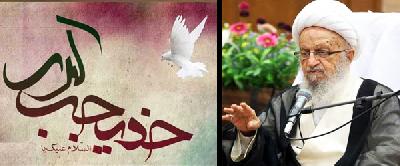
“Following thorough investigation in valid sources we found that Hazrat Khadija was 26 or 28 years old when she married Prophet Muhammad while the Umayyad introduced her as 40 year-old widow and propagated among Muslims which was clearly a conspiracy against her,” Ayatollah Makarim Shirazi Said.
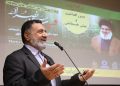
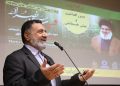
Expressing condolences on the death anniversary of Hazrat Khadija, the Lady of Islam, in an Iftar feast held in Allameh Tabatabaie Darul Quaran (a kind of school in which Quranic lessons are taught) with the attendance of seminary instructors, Ayatollah Makarem Shirazi delivered a speech on the biography of Hazrat Khadija, stressing that many useful points could be drawn from her life to be applied by today’s Muslims, especially Shiites and Iranians in their everyday life.
Referring to the living conditions of Prophet Muhammad (P.B.U.H) in Mecca and Medina, he added that the period in which the Prophet (P.B.U.H) lived in Mecca was disastrous in real sense of the word; It was an era of great calamities, tragedies, limitations, tortures, and hardships; It, but the Medina era was full of happiness and Muslims experienced many victories one after another. In other words, the atrocities endured by Muslims during their living in Mecca were compensated throughout their stay in Medina.
“However, Hazrat Khadija was one of those Muslims who merely lived during the difficult days of Mecca era and experienced nothing but great sufferings. For instance, she used to daily bandage the wounds inflicted on the Prophet’s body through stoning and beating, which was really a distressing experience. However, the most difficult troubles which Muslims suffered in early days of Islam refer to the time when they were forced to migrate to Shiʻb Abi Talib where they lived under the toughest boycott regime including a wide variety of social and dietary sanctions imposed upon them by the bullying atheists of their time, exactly similar to the ones implemented today against the Muslim world which would never work, as it did not in that time. That’s why we see that despite all such sanctions, Islam is increasingly spreading throughout the world”, he added.
“When I visited the tombs of Hazrat Abutalib, the Prophet’s uncle, and Hazrat Khadija I just understood what difficulties and sufferings Prophet Muhammad (P.B.U.H) and his faithful Muslim companions endured during their stay in Shiʻb Abi Talib. I could not tolerate the burning heat of the sun for even a few minutes while praying for them, but the Prophet and his followers lived there for three consecutive years under extremely tough conditions, i.e. burning summer heat, cold winters, no shelter, no medicine, and not enough food”, Ayatollah Makrim continued.
Describing the tolerance and resistance of Hazrat Khadija as laudable, Aytallah Makarem Shirazi said that although she did not see the victorious era of the Prophet she resolutely resisted against hardships when she was alive and that she enjoyed a very high epistemic position, as deducted from the Hadiths.
“Following thorough investigation in valid sources we found that Hazrat Khadija was 26 or 28 years old when she married Prophet Muhammad (P.B.U.H) while the Umayyad introduced her as 40 year-old widow and propagated among Muslims which was clearly a conspiracy against her. Hazrat Khadija was always a great helpmate for the Prophet”, he added.
Quoting Prophet Muhammad (P.B.U.H) as saying that Khadija always sympathized with me and provided me with all her means and possessions, Ayatollah Makarem Shirazi said that after the demise of her wife Khadija, the Prophet remembered her all the time, indicating that when a person does someone a favor and helps him/her in difficulties, he/she should be honored when alive and/or dead.
“One of the most important lessons we can learn from her life is that assisting Islam in time of peace, security and victory when it has reached all corners of the world is not as valuable as it is when the religion is under different threats and helping it requires sacrifice and devotion”, he continued.
“Another lesson which could be learned from the life of Prophet Muhammad (P.B.U.H) and his wife Khadija is that the Meccan boycott of the Hashemites in Shiʻb Abi Talib could not stop Islam from spreading and moving forward and that the pressures which are currently being exerted on our country would not hinder the progression of the Islam and the Revolution. However, we need to be aware of out duties and perform them properly”, the Ayatollah added.