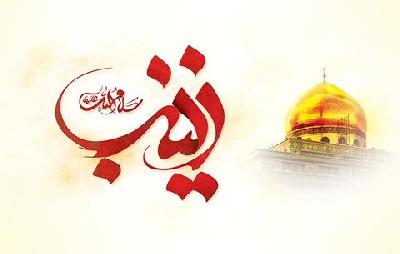
On the occasion of the birthday anniversary of lady Zainab peace be upon her.
by Marwa Osman*
“O the people of Kufah! Woe be upon you! Do you know which part of the Messenger of Allah you have cut? And which vow you have broken? And whose blood you have shed? And which respected family you have brought to the public (as captives)? And whose sanctity you have violated? You have done that, which could tear down the skies, open the earth, and make the mountains vanish. As far as the earth goes and as deep as the skies go, your obvious deed has no like, no similarity and no decency. Indeed you have done the ugliest, the most grievous and gruesome deed.”
With these words Hadrat Zainab bint Ali (as) confronted the people of Kufa who betrayed their Imam in Karbala. There is no doubt that Hadrat Zainab (as) is the shining sun in the history of Islam and of humanity. Her brother’s name “Imam Hussain” (as) and Karbala associate the idea of freedom, justice, humanity, virtue, fighting against despotism, with the realization of the sovereignty of Allah.
To fully comprehend the message of Karbala one has to fathom two thoughts. One is the rising of Imam Hussain (as) and the other is the rising of Zainab (as). Hadrat Zainab (as) was an outstanding figure in the history of Karbala endowed with divine steadfastness and fortitude. After the martyrdom of her brother and her two sons in the battle of Karbala, Hadrat Zainab stood tall and said: “O my Lord! Accept our humble sacrifice to You.”
Hadrat Zainab (as) became famous for her virtuous life. In her character she reflected the best attributes. In sobriety and serenity she was likened to her grand-mother Umm-al-Mumineen Hadrat Khadija(as), in chastity and modesty to her holy mother Hadrat Fatima(as) and in eloquence to her holy father Imam Ali(as).
Hadrat Zainab(A.S.) proclaimed to the world the greatest sacrifices made by her brother Imam Hussain (as) and other members of the family of the Holy Prophet of Islam(saw) who were brutally martyred at Karbala in 61 A.H by the forces of Yazid son of Muawiya. On the other hand, the women and children witnessed the very inhumane and merciless violence that took place in Karbala, yet they were not desperate, depressed, they did not collapse, despite all the pain and challenges, they were contrary the opposite. They stood up, spoke up and held Yazid responsible. They had no fear or anxiety but rather were very strong and decisive in their stances.
A part of the sermon Hadrat Zainab (as) gave with utmost bravery in the gathering of Yazid son of Muawiya in Syria shook his majlis (gathering) and still echoes through time and space:
“By Allah (SWT), you cannot remove us from the minds (of people), and you cannot fade our message. You will never reach our glory and can never wash the stain of this crime from your hands. Your decisions will not be stable, your period of ruling will be short, and your population will scatter. In that day, a voice will shout: “Indeed may the curse of Allah (SWT) be upon the oppressors…”
Righteous people should not at all be affected by the harsh circumstances they undergo, that is exactly what Hadrat Zeinab (as) stressed in her speeches. She reiterated they (AhlulBayt) are the people of strong presence, strength, confidence and faith despite the drastic and harsh calamity that fell upon her and her family. The prophet’s household turned this threat into an opportunity and made use of the entire situation and the circumstances they went through lead by the courageous Hadrat Zainab (as).
A model of defiance against oppression and injustice. A woman of patience and endurance. There was no act of worship greater than continuing the rising of her brother, delivering fiery sermons in the path of Kufa and Syria, and awakening ignorant people who were deceived by poisonous propaganda of Yazid son of Muawiya and martyred Imam Hussain (as) as a man who was out of Islam. Her sermons created a movement in Kufa and Damascus which shook the bases of Yazid’s kingdom and even Yazid’s son refused to replace his father as the king, and after a while, quitted the government while disgracing the oppressing dynasty of Umayyads.
In her lifetime, Hadrat Zainab (as) had endured immense pain from witnessing her loved ones martyred before her eyes, but she never objected to the destiny decreed upon her by Allah. The completeness of her submission is monumental. The grief she expressed was an outpouring of her incredible humanity.
Hadrat Zainab’s role was exemplary. It showed how bold Muslim women were and how they played a key role in consolidating Islamic teachings. Today, despite so much progress and the spread of education, so many Muslim women are suppressed. In some alleged Muslim societies, a woman’s voice is banned from even being heard in public; and here was Zainab (as) from the Imam’s family who became a public speaker to save Islamic values. The leadership of the family fell to Hadrat Zainab after Karbala, and she proved to be more than what was expected of her.
Today, women have to learn much from her example and leadership qualities. Her public role in the battle of Karbala has much to teach us both Muslim men and women. The only way for women in general and Muslim woman in particular could pay respects to her sacrifice is by being inspired by her life to be courageous in the face of tyranny, patient in times of trouble, and submissive to the will of God. Hadrat Zainab bint Ali (as) the role model for the righteous will forever teach us all that when we undergo countless trials in our lives, we should see nothing but beauty in them.
* Marwa Osman is a Media studies university lecturer at the Lebanese International University and a political commentator from Lebanon. She is also a member of The Blue Peace initiative’s media network.