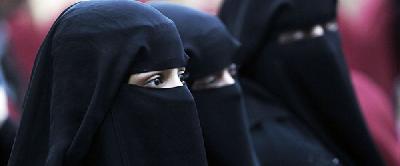
There has been difference in opinion even among the Muslims regarding the extent of permissibility of Niqab and whether it is really recommended or advised. Today, unfortunately the Niqab has been commonly worn or associated with the Wahhabis and Salafis, and some Muslims view the Niqab to be a taboo for Islam and are therefore against it.
Not too long ago, France took another step in its descent into full-blown religious intolerance, as police began enforcing the new law banning the wearing of face-veils, or what is known as Niqab. Several women have already been arrested for displaying the full face covering in public. In 2004, France passed a ban on headscarves in public schools, as well as other “prominent” religious symbols such as large crosses. This new law says, in effect, that if a faith requires devout women to cover their faces in public, they are no longer welcome in France.
It is well-known and agreed by all Muslims that what is obligatory for men and women to observe is Hijab – and for women, it entails covering of the body with the exception of the face and hands in front of un-related (non-Mahram) men. This is the bare minimum that every Muslim woman is commanded to observe, as supported by authentic prophetic narrations and the Holy Qur’an, “And say to the believing women that they cast down their looks and guard their private parts and do not display their ornaments except what appears thereof, and let them wear their head-coverings over their bosoms…” (24:31)
There has been difference in opinion even among the Muslims regarding the extent of permissibility of Niqab and whether it is really recommended or advised. Today, unfortunately the Niqab has been commonly worn or associated with the Wahhabis and Salafis, and some Muslims view the Niqab to be a taboo for Islam and are therefore against it. Others discourage their wives or other female members of their family from fully covering themselves including their faces, out of fear that it may affect their reputations or positions, or that they may be labeled as Muslims while they are actually striving to dissolve themselves among the crowds.
From the perspective of our jurisprudential scholars, it is emphasized that under some conditions, covering the face and hands is deemed obligatory or is strongly advised to be observed as an extra precaution. For example, in ruling #449 as cited in A Code of Practice for Muslims in the West, Ayatollah Sayyid Ali Sistani states: “A woman is allowed to keep her face and hands uncovered in the presence of a non-mahram man, provided that she does not fear of getting into a haram act, that the exposure of her face and hand does not cause men to gaze at her in a forbidden way, and that it does not give rise to immorality in general.” So, if a woman is noticeably wearing makeup, it is obligatory upon her to cover her face in some way or another. Other scholars of the past, such as Ayatollah Sayyid Abul-Qasim al-Khoei and Ayatollah Muhammad Ridha Gulpaygani, ruled that it is Ehtiyat-e-Wajib for a woman to cover her face in front of un-related men at all times. (A Code of Ethics for Muslim Men and Women)
Let us better understand this concept with respect to the Sunnah of the Prophet and his Ahlul Bayt (peace be upon them all) so that we draw a clear picture of where and how Niqab stands in Islam. We can reflect upon the following examples:
It is narrated that one day, one of the wives of the Prophet, Umm al-Mu’minin Safiyya bint Huyay ibn Akhtab went to visit him, and when she got up to leave, the Prophet stood up to walk her back home. On the way home, the Prophet passed by two men from the Ansaar who saw him and started hastening in their walk. So the Prophet called out to them, “Take it easy, she is Safiyyah!” From this incident, it is clear that his wife Safiyyah had her face covered when she was walking outside with the Prophet such that the people could not identify her. So, he identified the woman accompanying him to be his wife so that the minds of the weak do not entertain any devilish thought or doubt his chastity.
When Lady Zainab (peace be upon her) was present in the court of Yazid, what did she say to him? History records that she said: “Is it the custom of justice, oh accursed son of the ‘Released persons’, that you keep your ladies and concubines behind the veils (with respect) and at the same time you captivate and parade the helpless daughters of the Messenger of Allah as prisoners?! You snatched their veils and exposed their faces, and displayed them from one land to another, being viewed by those at watering places as well as those who guard your forts, with their faces exposed to the looks of everyone, near or distinct, low or elite, having none of their men with them nor any of their protectors?!”
From her statement, it is clear that the faces of the women of the household of the Prophet were usually not exposed in the streets such that Lady Zainab is now reprimanding Yazid for having their faces displayed leading to their violation due to staring of the strangers.
When Lady Zainab entered the court of Ibn Ziyad along with the caravan of captives, Ibn Ziyad spotted her among the captives. Historical narrations describe Lady Zainab by saying that “she was seated while disguised”. So Ibn Ziyad asked, “Who is that lady who is seated?” They informed him that she is Zainab. We get an impression from this incident that perhaps the custom during that time was that women would cover their faces when they were outside in public, but when they entered a court or an indoor setting or a comfort zone, they would show their faces to identify themselves. Since Lady Zainab kept herself disguised in the court, Ibn Ziyad saw that act as something out of the ordinary as he wasn’t able to identify her.
History records that Lady Zainab used to be escorted by the male members of her household to protect her honor and dignity whenever she walked outside. We can imagine that with this level of protectiveness over her chastity, Lady Zainab must have had her face covered when she went outside. This thought is confirmed when we hear someone narrating that, before the tragic events of Karbala when the caravan of female captives had their veils snatched away, he testifies that he never saw what Lady Zainab looked like except after her Hijab was confiscated! This only indicates that whenever Lady Zainab left her house, she veiled herself completely such that very few knew her physical features. It is extremely sad and to know that this same Lady Zainab who had her honor well-protected by the male members of her household, was taken as a captive with her Hijab confiscated in the streets of Shaam! May God remove His mercy from those who violated the honor of the women of the Prophet’s Household!
When the famous incident of burning the door of the house of Lady Fatima took place, it was in an attempt to force her husband, Imam Ali (peace be upon him), to give his pledge of allegiance to Abu Bakr. It is narrated that her husband was in the house with her along with some companions like Abu Dharr and Salman al-Muhammadi (may Allah be pleased with them) who accompanied Imam Ali and refused to give their allegiance as well. With the presence of other male non-mahrams in her house, it is clear that Lady Fatima would at least have her Hijab on. However, when the hoodlums sent by Umar barged into her house, she hid behind the door. This may indicate that since her face was not covered and she was used to covering her face outdoors in public, she hastened to conceal herself behind the door. After all, she was in the comfort of her own house and did not need to cover her face especially among those whom she knew well or trusted. And Allah knows best.
It is narrated that when Lady Fatima was ill after she was denied her right for Fadak which was unjustly seized from her, Abu Bakr sought to apologize to her and went over to her home. After being given the permission to enter her presence, Lady Fatima turned her face away from him. From this incident, we can deduce that if Lady Fatima had her face covered, then she wouldn’t need to turn her face away. After all, she was in the comfort of her own house. Perhaps, it is Allah’s wisdom that this detail was recorded in history so that the whole world may come to know that Fatima was angry at the first and second Caliphs, and this is proven by her physical gesture of turning away her face.
Logically speaking, we can imagine that surely the Lady of the Universe, the daughter of the Holy Prophet has to be fully covered from head to toe because she represents the best example to all human beings. After all, if she doesn’t cover her face to protect her dignity and honor to the fullest extent, then who will?
In conclusion, Niqab is a personal choice, and each woman should have the liberty to make that decision if she wants to wear it, and it is better for her if she does. The Shari’ah mandates that the leasش!
The article was written by Jerrmein Abu Shahba -originally from Egypt and guided by the grace of Allah (swt) to the truth path of AhlulBayt (as), obtained masters in Chemistry and is a Clinical Research Scientist by profession- and first published in islamicinsights.