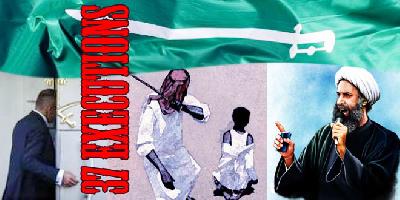
The Wahhabi ideology considers Shiʻism as innovation and justifies war against the Shiʻis and defends their persecution. Being official ideology of the Kingdom of Saudi Arabia, the Shiʻis of the country are on the wrong side and face discrimination in their daily lives.
The persecution of Shiʻis in the Muslim world has a long history and is normalised in the collective memory of the Muslims. Though the Shia-Sunni schism is part of the Muslim society and has also caused violence between the two communities from time to time. While understanding the shape of the tension one goes back to the ‘succession question’, but in recent centuries the state policies of the Sunni Ottomans and Shia Safavids have contributed to its growth. The two empires played with this schism to the best of their interests. It included employment of violence as well as warm-hearted proximity to each other.
The Shiʻism is considered to be the group of the people who not only opposed the dominant Islamic rule but also challenged it. This dissenting character of the group pushed it towards the margins of the Muslim world. Hence, the group slowly faced internal othering through stereotyping and structural discrimination. However, the Shiʻis too grabbed power at specific points in the timeline of the Muslim history and that further intensified the sectarian cleavage. Though the relation was not always tense and the instances of intellectual proximity and cultural exchange are also observed.
Nevertheless, the colonial and imperial infiltration made the Muslim world vulnerable, and it was for the first time in many centuries that the Muslim ualama as well as rulers, introspected and considered the sectarianism as a parochial tendency. The Muslim unity call of the personalities like Jamal u din Afghani and Allama Iqbal commenced a new chapter in the Muslim world view. The era can also be termed as the era of Muslim Revivalism and reformation, therefore under the project of Pan-Islamism Shia-Sunni anxiety too reduced.
The reformation movements among both the Shias and Sunni were driven by rationality and mutually influential. The reason was stressed to be employed to interpret the book and traditions, and the Muslims were able to generate the solutions from book and tradition. Consequently, the Muslims without succumbing to the Western ideologies were able to revive and reform their communities, this period can also be termed as the Muslim Awakening.
Though, the Muslim Awakening structured the Muslim world for the coming centuries and was at the forefront of many anti-colonial movements too. The main characteristic of the Islamic modernity is Shia-Sunni brotherhood. The idea is well indicated in the political and social thought of intellectuals like Allama Iqbal. In the case of Pakistan, the country demanded by a Shia, Muhammad Ali Jinnah, says a lot about the influence of the Islamic modernists. The multiplicity of the Muslims in totality ensured peace and maintained good inter-sectarian relations.
However, the Wahhabi call of returning to the fundamentals revived sectarian tension once again in 19th century. The Wahhabi ideology considers Shiʻism as innovation and justifies war against the Shiʻis and defends their persecution. Being official ideology of the Kingdom of Saudi Arabia, the Shiʻis of the country are on the wrong side and face discrimination in their daily lives. The kingdom is said to have 20 per cent of Shiʻis in its oil-rich Eastern Provinces that also borders the other Shiʻi majority country in the region, Bahrain.
The structural wrath against the Saudi Shiʻi is also justified by the imaginary Iranian connection, as the Kingdom had to see Shiʻi uprising against the discrimination after the Islamic Revolution of Iran. However, the uprisings should be understood as the result of the Wahhabi onslaught and second class citizen treatment. The Iranian connection is unsubstantial for the multiplicities of the religious authority in Shiʻi Islam and Iraq is the case for that.
The ideas of Islamic Revolution of Iran also constituted antagonism with the monarchic rule, Zionism and the West. Therefore, the ideas were threatening to the Western hegemony in the region and containment of such Ideas occupied the policy world of the West. This state of affair constantly attempted to delegitimised the influence of the revolutionary ideas and hence the Shiʻi voice in the region is continuously anticipated as terrorism and Iranian proxy.
The American war on Iraq destabilised the country and surfacing of the sectarian tension was a huge consequence of it. The Iran anxiety of the US accelerated the sectarian tension even when Iraqi Shiʻis were independent of Iran. The Hezbollah that is a resistance force against the Israeli Defence Force, in Lebanon too became the victim of sectarianism for its role in the 2006 War and war against ISIS. The Saudi Shiʻis like any other Saudi citizen are demanding their rights and protection and well understand that Iranian connection is dangerous for them. But the Iran Anxiety is building perception that it Iran all over.
The race for hegemony is severely affecting the lives of ordinary people, and the feud has already spread all over the Muslim world and is in the drawing rooms today. The countries like Saudi Arabia and Iran are to some extent homogenous but the neighbourhoods that are mixed and people are inter-dependent can have uglier effects. The Saudi Shiʻis are facing vertical and horizontal discrimination not for being Iranian proxy but for being Saudi citizens. The given identity, geographic location and contribution in the economy of the Saudi Arabia, the structural discrimination can only destabilise the country. Hence the Saudi Shiʻi Question must be seen through people-centric lenses only and not through political lenses of the Realist States.
The Article was written by Khairunnisa Aga, an Islamic research scholar at Jawaharlal Nehru University of New Delhi.